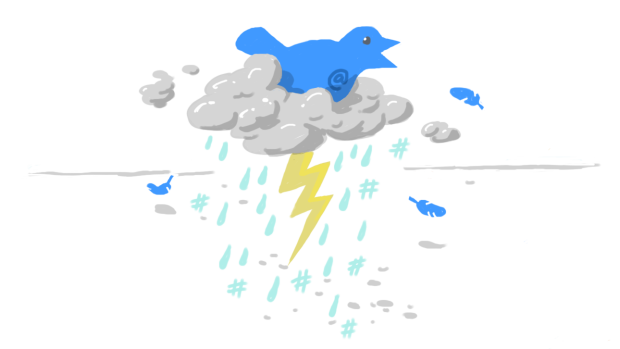
Get Your Umbrella Ready – There’s a Tweetstorm Coming!

twitterstorm1

 In January 2015, a mere 11 months ago, Twitter’s founder, Jack Dorsey, endorsed the multi-tweet “twitterstorm” as a clever means of rapid-fire marketing. He wrote:

tweet

Dorsey also noted that tweetstorming was a pretty brilliant way to maneuver around the 140-character limit, and that it wasn’t the first time that users had built platform features that Twitter designers hadn’t thought of themselves.

In fact, it took Dorsey a series of 17 tweets to talk about his support of Tweetstorming. Charlie Warzel, of Buzzfeed, chimed in quickly with a response that Twitter’s newest trend was totally out of line and “Must Be Stopped.”  Warzel’s reasonable claim? Get a blog.

Dorsey not only lauded the notion of Tweetstorming, but also the introduction of video, photos, and other improvements like direct messaging and a mobile video camera. Many users cheered along with him. Conversing with a group, privately? Hurrah! Capturing and sharing videos right from your Twitter app? Amazing! The Twitter experience can now be full and rich. With just a few taps, you can add new dimensionality to previously flat and non-immersive text-only media.

By July, the concept and term had become popular enough, and had gained enough ground, that Twitter applied to trademark the word, “Tweetstorm.” No lie.

But, wait. What does this have to do with technical writing?tweetstorming
I cannot imagine the things it does NOT have to do with technical writing.

If I am now able to Tweet a set of user steps as a Tweetstorm, steps 1-12, for example in a series as simple as 1/1,1/2, 1/3 and so on so that users can see my Twitter handle and the steps they take, and I can imbed a photo or video along with what they need to do, or even use a screen capture of an on-site step, or a photo of the machine, the shop, the location or the outcome. I have now crossed over in real-time to becoming the most useful tool in the arsenal.

And if I can sit with a developer or support team member and walk-through the issue that a customer is having with the software we have developed, or I can be in the room with my Development Team and a User Experience Designer, a whiteboard and a Product Owner, and live-tweet the whole experience while we develop the documentation, then the medium gets the message.

This particular use of Twitter moves it from social to business and targets my audience with precision heretofore unimagined my Twitter, but that – in eleven short months – could be elegantly applied by businesses like agile software development in a global capacity with full force, especially by teams of document writers who may be located time zones away.

So, Charlie Warzel, while I sympathize that Tweetstorming is indeed not the proper forum for detailing your last evening’s date or repeating the behavior of the passenger next to you on the airplane, I caution that it may be that tech writers will co-opt Twitter in much the same way that thirtysomethings took over Facebook.

Better buy some gtweetstormeraloshes. There could be a heck of a tweetstorm.

Can Software Write This Better than Me?

In my job, Icomputer writer’m expected to use a variety of tools to ensure accuracy, word count, compliance, style – adherence to a host of things that keep me “in line” with the company’s overall design and standards. This causes me to wonder: as part of a team of software developers, could my team design software that automates the process of writing the documentation for their own software with enough accuracy that the documentation specialist goes the way of the dinosaur?

I mean, the whole point of some of my products is to automate processes that human beings used to perform, and to automate them to such a degree of precision that people are hardly required to be cognizant, let alone present, for the actions these programs perform. We’ve designed such reliable systems that banking, health care, military information and community design can count on big data to gather and maintain the necessary materials to run our daily lives, and to store that data, to anticipate problems before the occur, and to rectify those problems with limited human intervention.

When you think, “but this type of automation cannot be applied to writing…writing requires critical thinking and analysis!” You would be correct. But you would be overlooking tools like the lexical analyzer Wordsmith, and the automated writing tool also named Wordsmith. Created by Automated Insights, Wordsmith is the API responsible for turning structured data into prose – it literally takes baseline information and makes an article. Could I be out of a job?

Feed me some data, and I write articles, too, only you have to pay me and occasionally socialize with me. Not so for Wordsmith.

The freakish thing about Wordsmith is its accuracy. I’ve studied a good bit about semantic language interpretation, and in my graduate program at Carnegie Mellon University, I dabbled in software interpretation of language, working with a pretty notable team on designing huge dictionaries of strings of language. The thing is, computers are great at reading – they can read at much faster rates than humans, they can digest huge chunks of information and store that information at infinitely larger capacities than the human brain can and their recall is spectacular. Skeptical? Just watch the amazing Jeopardy matches between IBM’s Watson and you’ll soon see that computing power can be harnessed to cull through the informational equivalent of roughly one million books per second. Humans just can’t keep up. Humans who write can’t touch that.

If computers learn a perfect formula for the Great American Novel, we are doomed.

Something to consider. Let’s try to keep this a secret from my bosses, shall we? My team of very excellent software developers may decide that this is a project worth undertaking, and the next thing you know, it won’t be just data that Wordsmith will be analyzing.

In the meantime, I will rely on the human eye and the need for context clues and interpretation that Wordsmith and Watson lack. I’ll count on the systems of reliability and emotion. I’ll count on what I know. What I learned in that high-functioning graduate analysis: A computer cannot tell the significant difference between these two exchanges:

Scene 1: A funeral home. A somber affair, all is quiet. A man says to a woman:

“Sorry for your loss.”

The appropriate response? She shakes his hand and nods, quietly.

Scene 2: A soccer game. A sunny afternoon. The breeze is blowing gently.

A boy says to a girl:

“Sorry for your loss.”

The appropriate response? She high-fives him and replies, “No sweat! Let’s grab some pizza! Woooo hooo!” As they tumble into a minivan, shouting jubilantly, kicking off their shoes.

No computer can decipher the differences in – “Sorry for your loss.”

Sorry, Wordsmith.

I’m going out for pizza.

Want The Very Best in UX? Hire a Writer

Saying that all technical systems, website creation teams, and indeed software development companies can benefit from a User Experience Designer is like saying that all human bodies can benefit from water. It’s a simple assertion. We all know it, and yet some development groups assume that they know what is best for their customers, or worse yet, they assume their customers know what they want.
What they (the companies, not the customers) do not realize is that the easiest way to enhance the user experience is to hire a good writer. UX design encompasses art, yes, but it must essentially encompass understanding. This seems intuitive, and yet when we look to engage a User Experience professional we do not always assume that he or she is a talented writer.
How do I know this? Well, I used to teach within a professional seminar for the MA in Human-Computer Interaction at a highly-respected university where they were grooming tomorrow’s User Interaction Designers before I took this primo job writing amazing documentation for this crazy-talented company cranking out top-notch software. Surprisingly, though, when I landed here, we did not have a UX guru on our team. I was a bit taken aback that we didn’t have someone like that on the job, but I figured I was new, so I didn’t make waves. Besides, I knew all on my own that really, if there is no art involved, you don’t need interactiondesign, you need interaction writing. So UX talent is not required – a trusted relationship with your writing team is.
I’m not saying that a writer can replace a designer – that’s just bad math. A company that wants to succeed in designing good software, web interface, and more, needs to hire the people who have expertise in software development and web design. After all, writers can’t develop code! But what writers can do is parse the meanings of things. We have the highly developed talent for taking complex ideas of language and inference, metaphor and symbolism, and making meaning from them. And we can tell you when it just doesn’t work. And many of today’s writing programs require classes like Document Design, Communication Design, Visual Communication, and more – things that are akin to how users interact with the ways we are trying to reach them.

storytelling
Writers understand story. We tell stories. And in agile development, what do we call the very things that are on the table for development? Yes! Stories! In scrum meeting after scrum meeting, we task out stories for development, and the scrum master even relies on scenarios to help the team imagine how those jobs will be completed. It is proven in release after release that picturing how a certain element of the product will be used, valued, and consumed by the customer or end-user is a useful tool to the development team. Storytelling allows agile methodology to work, from start to finish. Good writers understand tension and pain, so writing a story or scenario helps to flesh out the documentation that will guide users through installation and troubleshooting. Writers are instrumental in sensing where and when the struggle points will hit for the team long before the software is released for general audiences.
Writers “get” emotion. We deal with it all the time in storytelling. Put a writer in the room in every scrum meeting and just watch how a talented one can help diffuse tense moments over hours invested in an idea that didn’t pan out. It isn’t foolproof, but a writer is also a good catalyst for humor, empathy, kindness and redirection in the heat of the moment. Many writers have a genuine interest in the investment of people, and writers can often help find a silver lining – if there is one to be found – and can redirect the energy. The User Experience is not always found on the outside of the room. Part of the experience is getting the product out the door without trauma.

traumaThe common argument against having a UX person on the team is cost, so often companies toss out the notion as a line-item veto in budget discussions. If there is a place for everyone at the table, that is fantastic, but in the current economy, often we are asked to develop multiple, portable talents. Those who can carry talents across the table are asked to do so. And they should.
The next time you are wondering how your customer might perceive something, I’d ask you to look across the table at your gifted technical writer, your talented copy editor, your incredible documentation specialist, and say, “How does this read to you? What do you think our customers will say? How does this look? What story does it tell?”
You might just be pleased with the answer. You may have found a user…with experience.